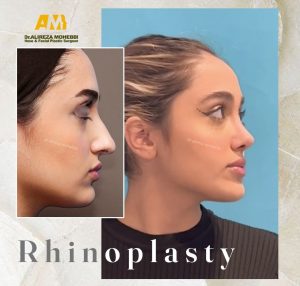
The trend toward facial cosmetic surgery has significantly increased among both women and men. You might even be considering a procedure like rhinoplasty . This article will provide you with all the essential information, dos, and don’ts to help you make an informed decision about this process. Nose surgery is a type of cosmetic surgery that alters the size, shape, and structure of the nose. It can reduce a prominent nasal hump, narrow a wide nasal tip, straighten a crooked nasal bridge, or make the nose more proportionate to the other facial features. This surgery can also help improve breathing. Join us as we explore this topic with Dr. Alireza Mohebbi, one of the best rhinoplasty surgeons in Tehran.
Benefits of Rhinoplasty
- Rhinoplasty can balance the nose with other parts of the face, enhancing overall facial harmony.
- If you’ve suffered from nasal obstruction for years, the positive results of this procedure can boost your confidence.
- Rhinoplasty is an outpatient cosmetic surgery, meaning you can go home the same day.
- Recovery is not very painful; the most uncomfortable sensation during this time is usually nasal congestion.
- When the structural tissue of the nose is treated through functional rhinoplasty, it can help resolve breathing issues.
Disadvantages of Rhinoplasty
- Rhinoplasty is relatively expensive, and insurance does not cover the surgery costs.
- For at least 14 days after the procedure, you will experience swelling and bruising.
- During the initial recovery period, some patients may experience nausea, vomiting, and a sore throat.
- Seeing the final results of rhinoplasty can sometimes take up to a year.
Ideal Candidates for Rhinoplasty in Tehran
According to the American Society of Plastic Surgeons, rhinoplasty is the third most popular cosmetic surgery in the world, with over 200,000 people choosing this procedure every year. Several factors determine whether you’re a suitable candidate for this surgery:
- The aesthetic and structural changes you seek
- Your budget
- Whether you can take two weeks off from work
- Facial features should have reached maturity before rhinoplasty; teenagers should ideally wait until at least age 17
The Difference Between Open and Closed Rhinoplasty
There are two main types of cosmetic rhinoplasty: open and closed. The primary difference between open and closed nose job is that in the open method, a small incision is made under the nose (called the columella), while in the closed method, all incisions are made inside the nose.
In the open approach, this incision is usually well-hidden and only visible if you tilt your head back. The skill of a rhinoplasty surgeon in Tehran or other cities is the most important factor in achieving good results. In open rhinoplasty, the surgeon can better visualize and make precise changes to the nose’s structure. To learn about the post-operative instructions recommended by Dr. Alireza Mohibi, an ENT specialist in Tehran, please refer to the related article on the website. It’s worth mentioning that Dr. Mohebbi uses silicone nasal packing to improve breathing instead of regular packing.
Endonasal Rhinoplasty: A Closed Approach
In closed surgery of nose, also known as endonasal rhinoplasty, all incisions are made inside the nostrils. Although the incisions encompass nearly half of the inner lining of the nostrils, no external cuts are made, leaving no visible scars after the surgery. Since the incisions are made separately in each nostril and do not connect, the skin of the nose cannot be lifted, making it slightly challenging to reposition the skin in a new position. Due to the avoidance of external incisions, this technique has technical limitations regarding access to the inner structure of the nose.
External Rhinoplasty: An Open Approach
In contrast to closed nose job, open rhinoplasty uses a small incision called a trans-columellar incision to connect the incisions made inside the left and right nostrils. Through this 4-5mm incision, the nasal skin can be lifted (like the hood of a car) to expose the lower nasal structure. This allows the surgeon to directly observe the entire nasal framework and reposition each element in a standard position.
About the Trans-columellar Incision
One of the most critical technical aspects of open rhinoplasty is the precise suturing of the trans-columellar incision. When closed with accurate sutures, virtually no scar remains, and no elevation is formed in the scar.